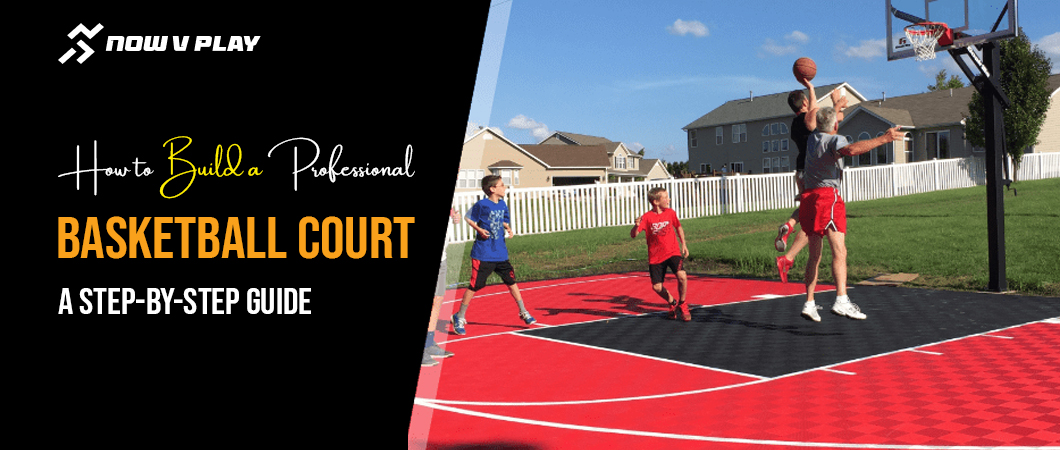
To construct a top-tier basketball court, it’s critical to understand official dimensions and materials for pro-level play. A standard court measures 94 feet by 50 feet for NBA/NCAA and 28 by 15 meters for FIBA. Surface materials vary but must ensure consistent bounce and grip—commonly hardwood indoors or asphalt/concrete outdoors. You’ll need to comply with perimeter clearances, subsurface drainage, and foundation specs. Professional-grade sports surfacing enhances player safety and performance. Planning around key requirements ensures the court meets referee and facility standards. Clear knowledge of official measurement conventions protects your investment and guarantees a professional basketball court that withstands rigorous use.
Choosing the Right Location for Your Basketball Court
Selecting the perfect location for your basketball court involves evaluating zoning codes, climate, solar orientation, and accessibility. Ensure the land is level or can be graded; sloped sites may require extensive excavation. Outdoor climates affect surface longevity: high UV may fade asphalt, while wet regions need good drainage. Consider proximity to power lines for lighting and easy access for players and maintenance equipment. Avoid areas with overhead obstacles like trees that could disrupt play. A strategic location enhances usability, safety, and longevity. Thoughtful planning here is crucial to creating a professional basketball court that delivers consistent enjoyment season after season.
Planning the Layout and Design of the Basketball Court
When designing your basketball court, precision matters. Position the court with minimal east-west exposure to avoid glare from the sun. Allow a recommended 10-foot buffer zone around boundaries for player safety. Map out official three-point arcs, free-throw lanes, center circles, and hash marks using precise measurement tools. Ensure goal post placements align with your chosen competitive standard (NBA, FIBA, or NCAA). Drainage-grade slope—usually one-quarter inch per foot—prevents pooling. Also incorporate space for equipment, benches, and possibly spectator seating. A well-planned layout supports both formal competition and casual play, turning your basketball court into a versatile, professionally designed space.
Selecting the Best Surface Material for a Basketball Court
Choosing the right surface for your basketball court is fundamental to safety and performance. Outdoor courts are typically built with asphalt—durable and cost-effective—or concrete, which offers better long-term flatness. For indoor, maple hardwood is the gold standard, delivering consistent bounce and player comfort. Modern modular sports tiles, such as polypropylene or PVC, offer shock absorption and easy installation on various substrates. Each option has trade-offs: asphalt is affordable but cracks, concrete lasts longer but is harder on joints, and tiles add cushioning and visual appeal though cost more initially. Choose based on climate, usage frequency, comfort, and budget.
Installing the Sub-Base and Surface Layers
To build a durable basketball court, begin with a sturdy sub-base. Excavate to remove organic soil, then compact crushed stone in layers using a plate compactor. This prepares the foundation for asphalt, concrete, or modular tile systems. Next, install a binder course of asphalt if using asphalt surface or pour reinforced concrete with wire mesh for rigidity. For indoor or modular outdoor courts, lay a vapor barrier, plywood subfloor, and shock-responsive underlayment before installing the top surface. Accurate grading and compaction at this stage prevent uneven settling, cracking, or drainage issues down the line—ensuring your professional basketball court offers a level, resilient playing surface.
Painting and Marking the Basketball Court Accurately
Proper markings elevate your basketball court to professional standards. After the surface cures, apply primer before painting boundary lines, key areas, three-point arcs, and free-throw lanes using stencils and layout chalk. Use weather-resistant acrylic or epoxy paint rated for sports surfaces. Adopt official colors and widths—typically 2 inches for lines. Use measuring tapes, string lines, and chalk lasers to ensure accuracy. Consider adding logo or branding designs with masking tape and multi-coat fill. Finish with an anti-slip sealant to withstand wear and weather. Consistent, precise court markings improve player orientation, visual appeal, and compliance with professional basketball court specifications.
Setting Up Hoops, Nets, and Backboards for Regulation Play
A professional basketball court demands regulation-quality equipment. Install floor-mounted or in-ground poles with 10-foot adjustable rims, tempered glass backboards (72”×42”), breakaway rims, and nylon nets. Follow NBA, NCAA, or FIBA specs: backboards should extend 4 feet from supporting structures. Ensure lateral stability with concrete footings and embed anchors precisely. Include padding around base plates and backboard support to enhance safety. Centerline alignment with court markings is vital for balanced gameplay. Quality equipment ensures official-style rebound behavior and player safety, delivering a true basketball court experience on par with school, club, or commercial facilities.
Lighting and Fence Installation for the Basketball Court
Proper lighting and fencing enhance usability of your basketball court. Outdoor night play requires uniform lighting—typically 50–75 foot-candles—achieved via tall pole-mounted LED fixtures angled to minimize glare. Position fixtures to avoid casting shadows across critical zones. Complement lighting with perimeter fencing—6-foot chain-link or decorative aluminum fencing keeps the court contained while allowing airflow. Gates should be lockable and pathways well-lit for safety. If wind is a concern, add windscreen panels. Thoughtful lighting and fencing improve security, reduce maintenance, and ensure your professional basketball court can be used evenings and on weekends without disruption.
Maintaining and Cleaning Your Basketball Court for Longevity
Routine maintenance ensures your basketball court remains safe and appealing. Sweep debris and leaves weekly, and wash the surface monthly with mild detergent and water. Inspect for cracks in asphalt or concrete and repair small ones with filler to prevent spreading. Repaint faded lines every 2–3 years. For hardwood indoor courts, maintain humidity levels and periodically refinish the surface to preserve bounce and grip. Check net condition and hoop stability occasionally. Seal asphalt surfaces every 3–5 years to protect from UV and moisture. With regular care, your professional basketball court will offer consistent performance and aesthetics for a decade or more.